The distributed platform made in Ferments du Futur
You may have already heard of it if you’re familiar with Ferments du Futur, even if only in passing: the distributed platform! Although it’s essential to how Ferments du Futur works, it can sometimes seem like an abstract concept—but don’t worry, in this article, we’ll explain everything.
Ferments du futur, a comprehensive ecosystem
Ferments du Futur is not an easy organization to understand, with its various governing bodies, partners, public, private, and associate members, competitive and pre-competitive projects, the CI2F, and so on. It is all these elements that make FdF the public-private partnership it is today, and among them, there is the distributed platform.
What is a distributed platform?
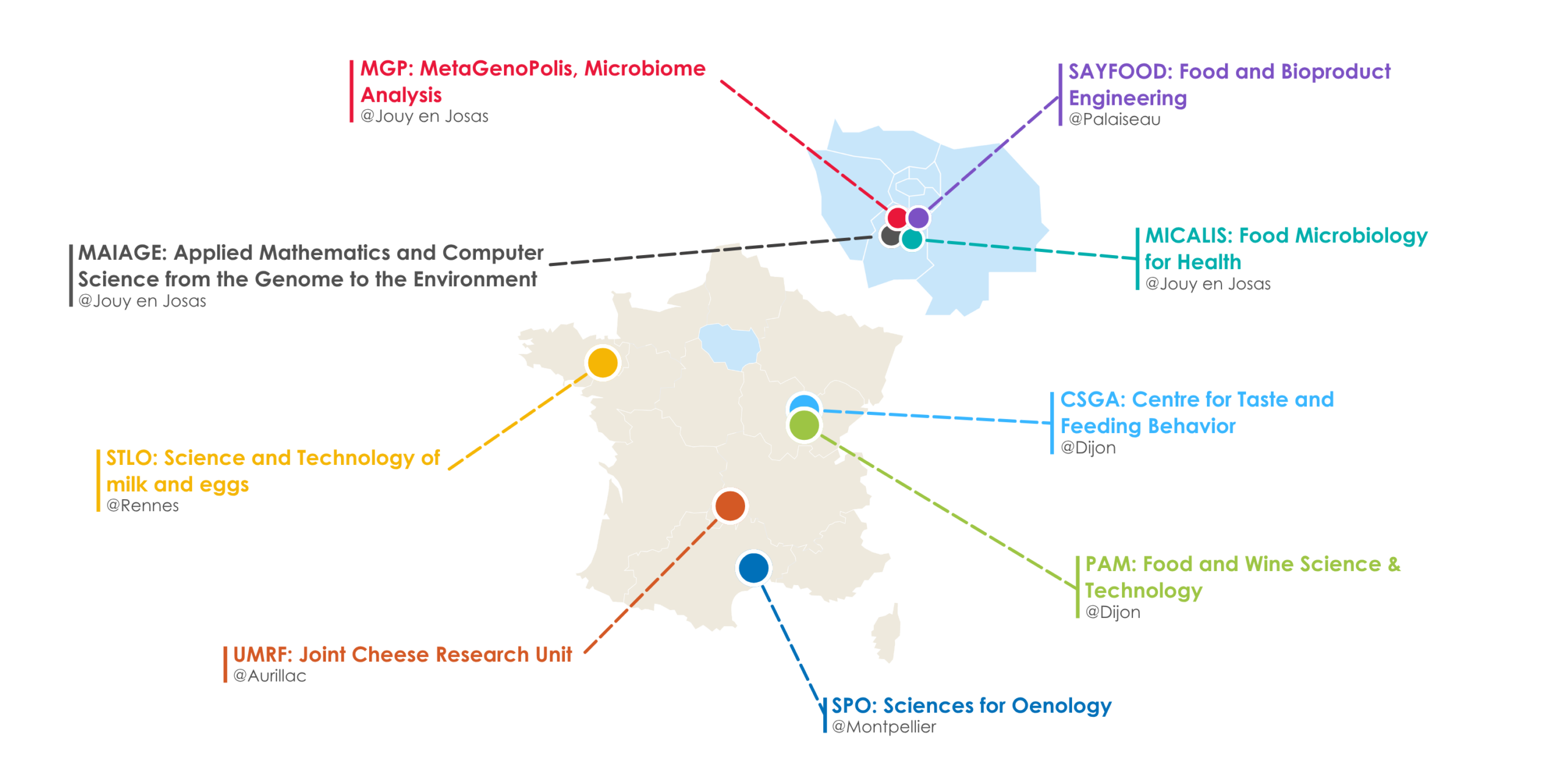
The distributed platform is a network of research units that work closely with Ferments du Futur. Within these units, we fund equipment and staff who contribute to Ferments du Futur projects. These collaborations enable direct and streamlined working relationships with academic partners specializing in food microbiology, process engineering and instrumentation, food-microbiome-health interactions, and data science.
Originally comprising 7 units at the launch of Ferments du Futur in 2022, two new units joined the distributed platform in 2026. In total, there are now 9 research units spread across France, in which Ferments du Futur is funding new equipment to strengthen existing technical capabilities and recruiting 15 staff members with expertise in these fields, supported on a daily basis by 11 lead scientists.
Together, Ferments du Futur and the units of the distributed platform form a network based on cooperation, knowledge sharing, and complementary expertise. This collective dynamic fosters the emergence of ambitious research projects and exceptional innovation initiatives, accelerates scientific advances in the field of microorganisms and fermentation, and helps address the major challenges of tomorrow’s food system.
The 9 units of the platform
CSGA – Centre for Taste and Feeding Behavior
The Centre for Taste and Feeding Behavior is a joint research unit whose research focuses on the study of eating behavior, its regulation, and its impact on well-being and health.
As part of our collaboration, a tribometer designed to conduct detailed studies of food breakdown in the mouth—including friction forces—will enhance our existing rheological capabilities.
MAIAGE – Applied Mathematics and Computer Science from the Genome to the Environment
MaIAGE is an interdisciplinary research unit dedicated to developing modeling, data analysis, and bioinformatics methods applied to issues in biology, agroecology, and the environment, from the molecular to the ecosystem scale.
Through its Migale platform, MaIAGE and FdF are collaborating on the Siduri data warehouse to aggregate and store data from FdF and make it accessible to various types of users.
MGP – MetaGenoPolis
MetaGenoPolis is a unit at the Jouy-en-Josas center specializing in microbiome science as it relates to nutrition and health. MGP proposes performant technologies to analyse complex microbiome diversity and interactions between gut bacteria and human cells
Ferments du Futur has installed 0.5-liter bioreactors there to study food-gut microbiota interactions.
MICALIS – Food Microbiology for Health
MICALIS is a joint research unit whose mission is to conduct innovative research in the field of food microbiology for the benefit of public health. The unit focuses on several topics related to this field, such as: the emergence and control of foodborne opportunistic pathogens, food and intestinal microbial ecosystems and their interactions, and microbial systems and synthetic biology.
At MICALIS, a 3D confocal microscope and a Biolector XT are funded for imaging microbial communities and screening their interactions.
PAM – Food and Wine Science & Technology
The Food and Wine Science & Technology Unit, aims to understand the physical, chemical, and biological phenomena that determine the quality of food and wine in order to develop new products and food processing methods. Within PAM, Ferments du Futur funds equipment for the separation and purification of small molecules to complement our comprehensive DSP offering.
SAYFOOD – Food and Bioproduct Engineering
SayFood is a multidisciplinary research unit dedicated to the study and innovation of food systems, from the processing of bioresources through to consumption. Its work aims to develop processes and products that are more sustainable, safer, and better aligned with societal expectations, by drawing on expertise in food science, process engineering, microbiology, and biochemistry.
SayFood has installed a high-resolution LC-Orbitrap MS and a DHS TDU GC-MS/MS system for metabolome and volatilome analysis.
SPO – Sciences for Oenology
The Sciences for Oenology unit conducts research addressing current challenges in the wine industry: adapting oenological practices to societal and environmental changes, understanding the evolution of yeast ecosystems in oenology, and characterizing changes in wine composition during production to propose innovative approaches and collaboratively develop technological solutions. The SPO’s work also extends to other fermented foods where the challenges and issues are similar to those in wine, such as bread, cocoa, and beer.
As part of FdF, SPO has access to a colony picker for MALDI-TOF identification of yeasts, enabling the accelerated isolation and characterization of strains of interest for fermentation.
STLO – Science and Technology of milk and eggs
STLO aims to generate knowledge about the components of milk and eggs, as well as their processing into ingredients or finished products for human consumption. By drawing on expertise in biochemistry, physical chemistry, process engineering, physics, technology, microbiology, and bioinformatics, its goal is to support safe, healthy, and good-quality food that is environmentally friendly and meets the needs of specific populations.
The partnership with STLO involves a suite of tools for culturomics (MALDI-TOF and anaerobic chamber), microbial phenotyping (Omnilog, oCelloScope), and peptidomics (nanoLC-TIMS-TOF).
UMRF – Joint Cheese Research Unit
The Joint Cheese Research Unit conducts interdisciplinary research on traditional cheeses to understand the microbiological, biochemical, and nutritional mechanisms that shape their quality. Its work aims to balance sensory quality, food safety, health benefits, and consumer expectations, while contributing to the advancement of cheese-making technologies.
At the UMRF, bioreactors containing cells encapsulated in gel beads for directed evolution are enhancing the unit’s capabilities through the Ferments du Futur initiative.
Sources
CSGA
MAIAGE
MGP
MICALIS
PAM
SAYFOOD
SPO
STLO
UMRF
https://csga.fr/en_GB/introducing-the-centre
https://maiage.inrae.fr/
https://mgps.eu/about/who-we-are/
https://www.micalis.fr/micalis/
https://umr-pam.fr/en/pam-lab/presentation
https://eng-umr-sayfood.versailles-saclay.hub.inrae.fr/
https://spo.montpellier.hub.inrae.fr
https://eng-stlo.rennes.hub.inrae.fr/umr-stlo/description-of-umr-stlo
https://umrf.clermont.hub.inrae.fr